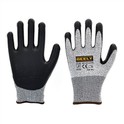
Cut resistance levels for gloves are standardized to measure how well gloves protect against cuts, slashes, and abrasions. These levels are typically based on standards like ANSI/ISEA (American National Standards Institute/International Safety Equipment Association) or EN 388 (European standard).
Here's a breakdown of the differences in cut resistance levels:
**ANSI/ISEA Cut Resistance Levels (North America)**
The ANSI/ISEA 105 standard measures the cut resistance of gloves on a scale from A1 to A9. The higher the number, the greater the level of protection.
1. **Level A1** (200–499 grams of cut resistance)
- **Use Case**: Minimal cut hazards; light-duty tasks like general assembly, material handling, or packaging.
- **Protection**: Low-level protection against minor risks.
2. **Level A2** (500–999 grams of cut resistance)
- **Use Case**: Light cut risks, such as small sharp objects in warehouses, light manufacturing, and general maintenance.
- **Protection**: Slightly more protection for handling sharp edges.
3. **Level A3** (1,000–1,499 grams of cut resistance)
- **Use Case**: Moderate cut hazards, common in industries like construction, light automotive work, and warehouse operations.
- **Protection**: Adequate for handling slightly sharp materials, such as metal parts.
4. **Level A4** (1,500–2,199 grams of cut resistance)
- **Use Case**: Medium cut risks, such as handling sheet metal, glass, or sharp tools in industries like automotive, metalworking, and assembly.
- **Protection**: Suitable for handling sharper objects or tools.
5. **Level A5** (2,200–2,999 grams of cut resistance)
- **Use Case**: Higher cut hazards, like working with glass, metal fabrication, and certain industrial settings where sharp materials are common.
- **Protection**: High cut resistance, providing solid protection against sharp blades or materials.
6. **Level A6** (3,000–3,999 grams of cut resistance)
- **Use Case**: High-risk environments like glass handling, metal stamping, or food processing industries with high cut risks.
- **Protection**: Strong protection for frequent contact with sharp materials.
7. **Level A7** (4,000–4,999 grams of cut resistance)
- **Use Case**: Severe cut risks, such as in heavy-duty metal fabrication, construction, or glass handling.
- **Protection**: Extremely high cut resistance for very sharp materials.
8. **Level A8** (5,000–5,999 grams of cut resistance)
- **Use Case**: Extreme cut hazards, such as in sheet metal, industrial manufacturing, and sharp object handling.
- **Protection**: Maximum protection in extreme situations.
9. **Level A9** (6,000+ grams of cut resistance)
- **Use Case**: Ultra-high-risk environments with constant exposure to extremely sharp materials.
- **Protection**: The highest available cut protection.
**EN 388 Cut Resistance Levels (Europe)**
The EN 388 standard uses a different rating system with levels from 1 to 5 based on the amount of force required to cut through the glove using a circular blade.
1. **Level 1** (1.2 Newtons / 102 grams)
- **Use Case**: Low-risk environments with minimal cut hazards.
- **Protection**: Very low cut resistance for simple tasks.
2. **Level 2** (2.5 Newtons / 204 grams)
- **Use Case**: Light cut hazards in industries like light assembly or warehouse work.
- **Protection**: Slightly higher cut resistance.
3. **Level 3** (5 Newtons / 509 grams)
- **Use Case**: Moderate cut risks, such as handling metal or glass in industrial settings.
- **Protection**: Mid-level protection against cuts.
4. **Level 4** (10 Newtons / 1,020 grams)
- **Use Case**: Higher cut risks, such as glass handling, metal fabrication, or sharp tools.
- **Protection**: High level of cut protection for frequent exposure to sharp materials.
5. **Level 5** (20 Newtons / 2,040 grams)
- **Use Case**: Severe cut hazards in industries like heavy-duty metal fabrication, automotive work, and glass manufacturing.
- **Protection**: Maximum cut resistance.
Key Differences Between ANSI and EN 388:
- **Measurement Method**: ANSI measures in grams of pressure applied to cut through the material, while EN 388 uses Newtons with a circular blade.
- **Cut Levels**: ANSI offers more granularity with levels A1 to A9, while EN 388 uses levels 1 to 5, making ANSI more specific for high-risk applications.
- **Application**: Both standards are widely used, but ANSI is more common in North America, while EN 388 is widely used in Europe.
Choosing the Right Cut Level:
- **Low Cut Risk**: For light-duty work, like general maintenance or assembly, ANSI levels A1-A2 or EN 388 level 1-2 gloves are sufficient.
- **Moderate Cut Risk**: For handling materials like glass or metal parts, or working with sharp tools, ANSI levels A3-A5 or EN 388 level 3-4 gloves offer better protection.
- **High Cut Risk**: In environments like metal fabrication or automotive manufacturing with sharp blades or heavy materials, ANSI levels A6-A9 or EN 388 level 5 are ideal for maximum safety.
Selecting the correct cut resistance level depends on the specific risks in the work environment, balancing dexterity, comfort, and protection.