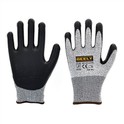
PU coating gloves have their own characteristics. It is tough, long lasting and very thin. Because of this feature, it is very suitable for precision work, or just to protect and keep hands clean.
PU material scores high in terms of wear resistance. Due to its soft and stretchable properties, it still provides good puncture resistance without being too bulky, so it is generally considered an ideal coating for cut-resistant gloves. PU coating is durable and flexible, making it an excellent coating for general sharp processing and assembly in many industries such as manufacturing, aerospace and precision assembly.
The disadvantage of PU coating is that it has a higher level of penetration into the knitted lining, which can cause skin sensitivity problems. PU is also an impermeable coating, so it is usually used as a finger or palm immersion glove to reduce sweat in the glove.
Nitrile Coated
A Nitrile coated work glove is three times more puncture and tear resistant than natural rubber like latex. Nitrile stand ups well to chemicals and oil and can withstand a relatively wide range of temperatures. Another bonus of Nitrile coatings is that it has the option to be foamed. This means, that when you’re using the glove and you come in contact with surfaces that are smooth and oily, the Nitrile coating acts as a sponge, so that your grip is maintained.
Latex Coated
A latex palm coating typically have higher elasticity than other coating materials as well as one of the best grips of many other palm coatings as well. Latex palm coatings make for very versatile work gloves because they can withstand extreme temperatures, resist common chemicals like alcohols and some ketones, and has great tear resistance. It does not perform well with hydrocarbon and organic solvents like gasoline. However, due to allergy problems, sometimes this options has to be eliminated.